The numbers explain why this matters more now than it did three years ago.
African startups raised about $3.1 billion in 2025, up from $2.2 billion the year before (Launch Base Africa). But the rebound came with strings attached. The continent minted no new unicorns all year, and debt financing swelled to roughly 45% of the total, as investors backed companies with hard assets over ones burning cash for growth.
2026 has held to that pattern. Startups raised about $1.44 billion in the first half, a shade above the $1.42 billion in H1 2025. The headline looks flat, but the shape underneath it has changed completely: that money came from just 146 disclosed deals, down from 252 a year earlier. Fewer companies are raising, and the ones that do are raising bigger. Meanwhile, mergers and acquisitions hit 63 deals, nearly double the 33 in H1 2025, as companies that couldn't raise chose to merge rather than shut down.
For Nigerian founders, there's a genuine bright spot inside all that tightening. In the first half of 2026, Nigerian startups raised $214 million in equity, and $254 million once debt and grants are counted, according to Africa: The Big Deal. That equity haul edged out Egypt's $183 million to make Nigeria the continent's largest market for pure equity investment, its strongest half since 2022. The capital is there but it's just harder to reach, and it flows to a narrower set of companies: the Big Four markets alone accounted for about 58% of everything raised on the continent in the period.
Here is the number every founder planning a raise should sit with. Of the startups that raised a seed round in 2021, only around 5% went on to raise a Series A within two years; for the 2022 cohort it was closer to 4%. Those companies didn't all fail because the market turned. Plenty of them simply couldn't show, with evidence, that they'd used the first cheque well.
What has actually changed
Most founders prepare for a raise by working on the deck. They rehearse the story, sharpen the market size, and rebuild the projections. Then diligence starts, an investor asks for twelve months of clean financials, and the work that actually decides the round begins from scratch.
In 2021, a good story could carry a round. Growth was the only metric that mattered and discipline could wait. That era is over. Capital is scarcer and far more concentrated now, and when investors are being this selective, they spend longer in diligence. Diligence is the moment financial operations stop being back-office housekeeping and become the thing being judged.
What investors are really checking
Working across accelerators, funds, and founders, the same pattern surfaces in almost every conversation. Nobody is looking for perfect books. They are looking for evidence that money moves through the business in a way somebody controls. In practice that comes down to five questions, and each one has a fix you can put in place long before anyone asks it.
Where did the money go? If answering that takes two weeks of piecing together old transactions, your records are already telling you something. The fix is to close your books every month, not once a year. Founders who close monthly can answer almost any financial question in a day. Founders who close annually spend their time reconstructing the past instead of running the business.
Who approved it? Every payment needs an owner. A company where the founder signs off on everything won't scale, and one where nobody signs off on anything is hard to trust with a bigger cheque. The fix is to put controls in before you need them: cards with limits, an approval and policy flow, receipts captured at the point of spend rather than at month end. Controls bolted on under diligence pressure look exactly like what they are.
What's the actual runway? A number you can produce today, off real burn, that doesn't shift the moment someone remembers an unpaid invoice. The fix is to keep your core numbers in your head: burn, runway, gross margin, and your three largest cost lines. An investor who asks these in a meeting is quietly checking whether you run the business or it runs you.
Do the numbers agree with each other? Your accounting system, your bank, and your management reports should all tell the same story. The fix is to separate business and personal money completely. This is still the most common finding in early-stage diligence and the most damaging, because it signals a founder who hasn't made the shift from running a project to running a company.
How fast can you answer? Speed is a signal in itself. A founder who turns a data request around in 24 hours reads as a different kind of operator from one who takes two weeks. The fix is to build the reporting before the first cheque lands. The reporting an investor expects after the round is the same reporting that proves you deserve it, so set it up early and diligence becomes a formality.
The part nobody says out loud
There's a real tension under all of this, and it's worth naming.
Founders resist opening their books to investors because it feels like surveillance, and nobody wants their cap table watching every naira in real time. That instinct isn't unreasonable. But the founders who raise well tend to land on the same conclusion: transparency you control is leverage. When you decide what to share and can produce it on demand, you're not being audited. You're proving you run a business worth backing, and making it easy for someone to say yes.
The difference between those two experiences isn't attitude. It's a system.
Start before you need to
The best time to build financial discipline is about a year before you raise. The second best is now. None of this is hard work. It's unglamorous, which is exactly why it gets pushed behind the deck. But in a market where fewer than one in ten seed-funded companies reach the next round, the ones who make it through are rarely those with the best story. They're the ones who can prove it.
And that proof isn't something you write. It's something the business produces as it runs, provided the system underneath is already recording who spent what, who approved it, and against which budget.
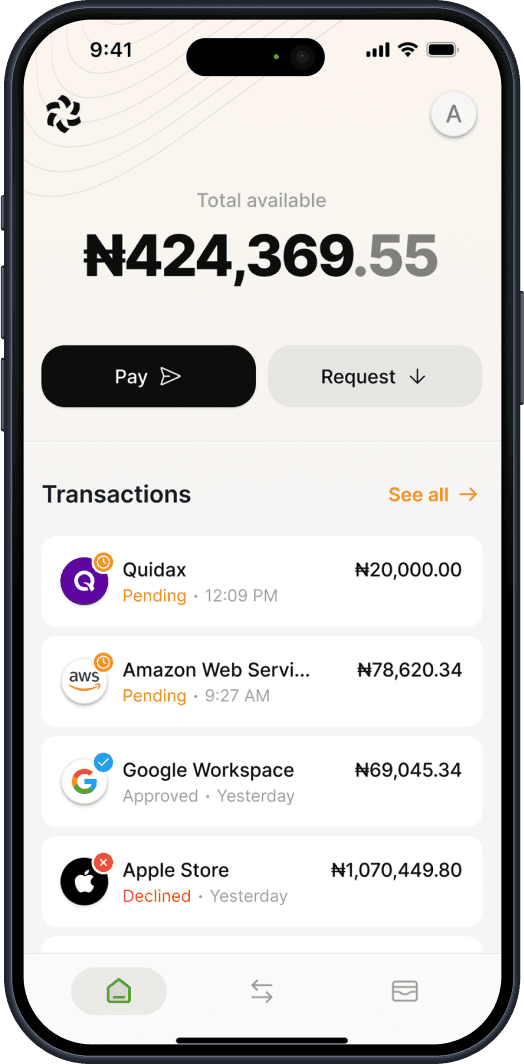
That's what Bujeti does. Expenses, approvals, corporate cards, payroll, and reporting in one place, so the record builds itself as money moves. When an investor asks for twelve months of clean financials, you're retrieving them, not reconstructing them.
Start building that record now, while it's cheap to set up and long before an investor asks for it. See how Bujeti works, or book a demo and we'll show you what twelve months of clean financials looks like when the system keeps them for you.