
Every finance process has a size it was built for. The spreadsheet that tracked expenses when your company had twelve people and one office was never designed to survive four branches, six project teams, three currencies, and a headcount that doubled last year. It did not fail because anyone did their job badly. It failed because the business moved past what a single file can hold.
The hard part is that spreadsheets rarely break loudly. Instead, the cracks show up as small, recurring frictions: a receipt goes missing, a budget that was already spent before anyone noticed, a month-end close that slips a few days later each quarter. Any one of these looks like a one-off. Together, they are a signal.
This piece is about reading that signal early, before a missing document delays a report, a budget overrun turns into a cash-flow problem, or an auditor asks for records you cannot produce on demand. Below are the patterns that tend to appear when a business has quietly outgrown manual expense tracking, and what to change when you see them.
Start with one question
Before the seven signs, one test cuts through most of the noise. Ask your finance team a simple question and time the answer:
How much has each department, branch, and project spent this month, and how much budget is left?
In a healthy process, that answer takes seconds, because the information already lives in one place. In a process that has outgrown its tools, it takes hours, because someone has to gather spreadsheets, reconcile bank portals, and chase the expenses that have not been submitted yet. If your answer arrives after the money is already gone, the rest of this article will feel familiar.
The patterns to look out for
Chasing receipts has become the job
The clearest early sign is where your finance team spends its time. When most of the week goes to following up for receipts, invoices, and proof of approval rather than analysing spend, the process has inverted. People who should be interpreting the numbers are instead assembling them.
This happens because a manual process scatters information across paper, email, spreadsheets, bank portals, and chat apps. Each missing item becomes another message and another delay before the books can close. And the errors are not rare. A widely cited GBTA Foundation study, run with HRS, found that roughly one in five expense reports contained errors or missing information, and that fixing each one added about 18 minutes. That research is now a decade old and focused on business travel, so treat it as illustrative rather than a precise benchmark. The direction it points in has not changed: small gaps get expensive when they repeat across hundreds of transactions.
The fix: Capture the receipt and the business reason at the moment of purchase, not weeks later. Keep the transaction, receipt, employee, category, and approval together in one record so nothing has to be reconstructed at close.
Answering "where is the money going?" requires a project
A growing business should not need an investigation to know which project is burning a budget or which subscription quietly crept up. If the answer depends on merging several files or waiting for month-end, the information is arriving too late to change any decision.
That lag has a real cost. Budgets and cash-flow plans built on last month's incomplete picture are, in effect, guesses. Leaders end up steering with a rear-view mirror.
The fix: Organise the way you actually run the business, by department, project, branch, entity, supplier, and currency. Give each manager a live view of their spend against budget instead of a report that lands after the fact.
The approval comes after the money leaves
A spreadsheet can record a purchase but cannot stop the wrong one before it happens. When employees spend first and seek sign-off later, you lose the only moment when the check actually matters: before payment. Finance is left reviewing decisions it can no longer influence.
The risk compounds across teams. One manager approves a request without knowing another team has already drained the shared budget. The review catches it, but the money is gone.
The fix: Move the control to the point of purchase. Route each request to the right approver by amount, department, project, or type, and flag anything outside policy before payment, not during a post-mortem. Keep routine approvals fast; reserve the extra scrutiny for large or unusual spend.
Nobody can prove who approved what
When everyone shared one room, a verbal yes was enough. At scale, that breaks down. Who approved this? When? Did they have the authority? The answer ends up split across an email chain, a chat message, and a spreadsheet total that records the amount but not the reason.
Clean approval records are not about mistrust. They protect the business and the employee by giving every decision a single, shared account, and they make it far harder for one person to request, approve, pay, and record the same transaction unchecked.
The fix: Hold the request, document, approver, decision, and payment status together, with distinct roles on higher-value payments. A good record answers four questions without effort: what was bought, why, who approved it, and which budget paid.
Reimbursements and month-end keep slipping
When employee reimbursements drags and close runs long, the cause is almost always manual handoffs. A claim is submitted, a manager replies eventually, finance verifies a receipt, someone updates a sheet, a payment is cut in another system. Miss one step and the whole chain stalls.
The cost lands on people. In Airwallex's 2025 Reimbursement Frustrations report, a survey of 2,000 employees, 45% said they regularly cover business costs with their own money, and most waited up to two weeks to be repaid, with more than a quarter waiting three to four weeks or longer. That study is UK-based, so the exact figures will not map onto every market, but the underlying dynamic travels: when reimbursement is slow, employees quietly stop submitting small expenses, and finance loses visibility into spend that is actually happening. Meanwhile, close arrives with gaps because some expenses were never entered.
The fix: Set a clear submission and approval timeline, prompt automatically for missing receipts, route claims to the right manager, and connect approved expenses straight to payment and accounting so the same data is never keyed twice.
The same mistakes keep coming back
One missing receipt is an oversight. The same missing receipt every month is a process telling you something. Watch for the repeats: duplicate claims, wrong categories, expenses booked to the wrong project, purchases over the limit, claims filed long after the fact. Each one erodes trust in the numbers and burns finance time on corrections that should never have been needed.
Manual processes also hide the unusual. A duplicate payment looks like two ordinary lines in two files. A personal purchase blends in when no business reason is recorded. An out-of-policy exception slips through because the reviewer could not find the rule fast enough.
The fix: Track the type and frequency of errors for three months. If your team keeps fixing the same issues, change the process rather than asking people to try harder. Systems that check for missing fields, match receipts to transactions, and apply rules automatically stop most avoidable errors before the final review.
The business now spans entities, branches, and currencies
Manual tracking usually breaks not from volume alone but from complexity. Add subsidiaries, project teams, and multiple bank accounts, mix naira with dollars and pounds, let each location follow slightly different practices, and the problem stops being the number of expenses. It becomes the number of connections between them. Every payment now has to tie to the right entity, budget, currency, department, supplier, and approver, and every manual link is a chance for inconsistency.
This is sharper in African markets, where payment rails and financial systems are often fragmented. The IMF notes that digital payments are expanding fast across Sub-Saharan Africa even as interoperability, infrastructure, data privacy, and business continuity remain real challenges. And AfricaNenda, citing World Bank Enterprise Survey data, reports that only 35% of payments received by surveyed SMEs in Sub-Saharan Africa were digital. That figure covers payments received, not the full range of business expenses, but it explains why a finance team here often has to manage digital and non-digital records side by side, cleanly, in one system.
The fix: Run one process across every entity and location, with permissions scoped to each team. Support multiple currencies, connected bank accounts, separate budgets, and consolidated reporting, so local teams keep their autonomy while leadership keeps a single group-wide view.
The real shift is from recording to controlling
Manual tracking is not the villain here. A spreadsheet is still a fine tool for a small team or a quick analysis but the trouble starts when it becomes the control centre for company money that now moves through more people, more payments, and more decisions than one file can safely hold.
The point of moving to real expense management is not tidier record-keeping. It is the difference between describing what already happened and shaping what happens next, while you still have time to act. Control before the money leaves, visibility while decisions are live, and one reliable version of the truth when the board, the bank, or the auditor asks.
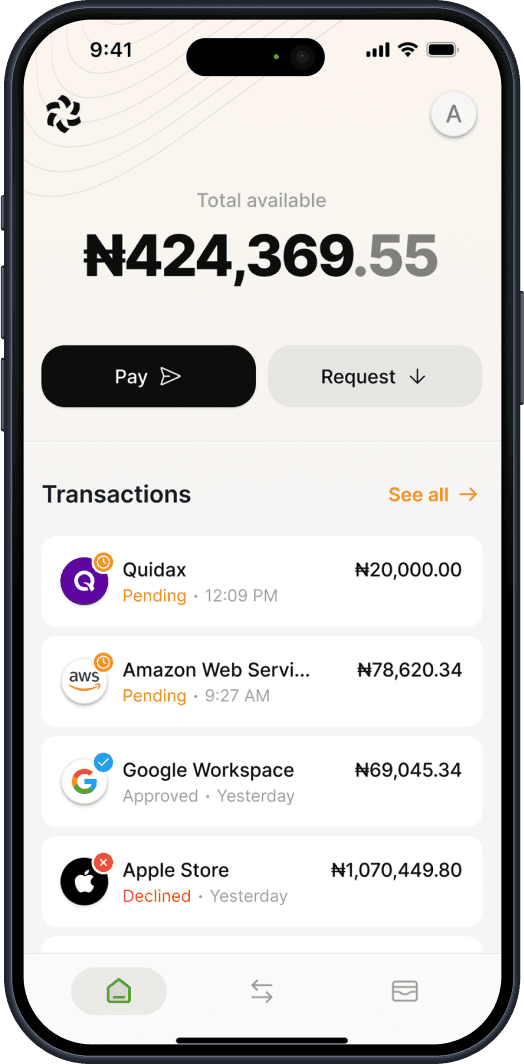
Bujeti brings expenses, approvals, corporate cards, payments, bank connections, and reporting into one place built for African businesses. Set spending limits, route requests to the right approvers, capture receipts as they happen, and see money moving across departments, branches, and entities in real time.