
You built your business from the ground up. Survived CBN policy changes, fuel price increases, naira volatility, and years of grinding it out. You finally have a team, a structure, and real revenue.
You also have someone on your team who has been there since the beginning. A trusted staff member who knows every vendor, every contract cycle, and every payment schedule. You trust them completely.
So when your accountant mentions the Q3 numbers look a little off, you wave it off. When a supplier says a payment came in short, you blame the banks. When petty cash keeps running out faster than it should, you put it down to rising costs.
Then one day, an external audit tells a very different story.
₦23 million. Gone. Over 14 months. In amounts small enough to look like noise. And the person responsible? Someone you trusted completely.
You sit in your office that night, laptop open, staring at spreadsheets that suddenly look like evidence instead of accounting records. Your hands shake slightly as you scroll through transactions you approved without really looking. Staff members you've known for years now feel like strangers. The business you built with your own sweat equity has been quietly leaking money while you focused on growth, on customers, on everything except the one thing you assumed was secure.
The worst part isn't even the money. It's realising you never had a chance of catching it.
The scale of the problem nobody talks about loudly
This isn't a rare story. It plays out regularly across Nigerian businesses of all sizes, and in almost every case, the business owner never saw it coming. Not because they were careless, but because their systems were never built to catch it.
The data is sobering. The ACFE 2024 report estimated that organisations lose an average of 5% of annual revenue to internal fraud. For a Nigerian business doing ₦200 million in annual revenue, that's potentially ₦10 million disappearing each year. Asset misappropriation, which includes cash theft, falsified expenses, and ghost vendors, accounts for 86% of all fraud cases globally. The average fraud case goes undetected for 12 to 18 months, usually discovered not by internal controls, but by accident or a tip-off.
Here's something worth stating clearly before we go further: there is nothing wrong with deeply trusting your team. The most trustworthy employee deserves a system that protects them from suspicion. Fraud controls are not a statement about your team's character. They are a statement about how seriously you take your business.
As the saying goes: the absence of temptation is better than the test of integrity.
And yet, here's the uncomfortable truth most business owners eventually admit: they've experienced some version of financial leakage. Inflated vendor invoices, unretired cash advances, petty cash that vanishes, phantom expenses buried in "miscellaneous." Most chalk it up to the cost of doing business in Nigeria.
It isn't. It's the cost of not having the right systems in place.
The usual way isn't enough
Let's be honest about the financial controls most Nigerian businesses actually run on.
"I sign every cheque myself" feels like control, but it isn't. Signing a cheque at the end of a busy week is not the same as verifying the invoice behind it. Is the vendor real? Does the amount match the original quote? Was this even budgeted? Signing is a formality. Verification is the actual control. They are not the same thing.
Informal processes create invisible exposures. Petty cash in an envelope with no trail. WhatsApp approval chains with thumbs-up emojis instead of formal records. Cash advances are given out on verbal requests with receipts that are always "coming," but rarely do. These aren't efficient shortcuts, they're structural vulnerabilities. A ₦500,000 payment approved via WhatsApp from a distracted executive is not a control. It's an exposure. Small informal transactions accumulate into significant losses over time, and by the time you try to trace what happened, there's no trail to follow.
One person handling too much creates opportunity. In many businesses, the same person who requests a payment can also approve it and reconcile the books afterward. This isn't efficiency. This is the single biggest structural risk in financial management. When initiation, approval, and reconciliation sit in the same hands, you're relying entirely on that person's integrity with no backup system to verify anything.
Reconciliation that happens weeks after the fact gives bad actors ample time to cover their tracks before anyone notices something is wrong. You should not be learning what happened to your company's money in October at a November board meeting.
How Bujeti closes the gaps
Protecting your company's money does not require treating your staff like suspects or hiring a team of forensic accountants. It requires building systems that make misappropriation structurally difficult and immediately visible when anything is out of place.
Think of it the way you'd think about installing security cameras in your office.
You don't do it because you assume your staff is dishonest. You do it because the structure protects everyone. It deters bad behaviour before it starts. It clears innocent people of false suspicion when questions arise. And it provides evidence when something genuinely goes wrong.
The camera doesn't make accusations. It doesn't create distrust. It simply makes the truth visible. That's exactly what good financial controls do. And that's the philosophy behind Bujeti's approach to spending control.
What spend control looks like in practice
Tunde runs a mid-sized logistics company with 85 staff across depots in Lagos, Port Harcourt, and Kano.
Before Bujeti: Weekly petty cash was distributed informally to depot coordinators. Payments were approved over WhatsApp. One shared corporate card had details known to three managers. Monthly reports were ready two to three weeks after the month-end.
During investor due diligence, ₦11.4 million in expenses could not be verified. A depot coordinator had been inflating vendor invoices by 15–20% for nine months before a whistleblower raised the alarm. The discovery nearly killed the investment round.
After Bujeti: Each depot operates within a defined monthly budget visible to headquarters in real time. Every coordinator has a Bujeti card restricted to their approved operational categories. All payments above ₦200,000 require two-step approval. Tunde receives instant notifications for every transaction on his phone. Month-end reconciliation now takes hours, not weeks.
Unverifiable expenses in Q1 2024: zero.
The invoice inflation scheme that cost ₦11.4 million? Structurally impossible under Bujeti. Here's how the same features that protected Tunde's business work for yours:
Budgets that work in real time, not in retrospect
Most businesses have budgets. The problem is they live in a spreadsheet nobody checks until month-end, by which point the money is already spent.
With Bujeti, budgets are live with active controls. You create budgets for every team, department, branch, or project, just like Tunde did for each depot. They operate in real time.
Every transaction is tracked against the assigned budget the moment it happens. When a budget approaches its limit, the right people are alerted immediately. When it's exhausted, spending stops automatically. No more end-of-month surprises.
Role-based access: separation of duties that actually works
Remember how Tunde's depot coordinator could both request vendor payments and process them? That's where the ₦11.4 million went.
The single most powerful fraud-prevention measure is the separation of duties. No single person should be able to initiate, approve, and reconcile a financial transaction.
Bujeti's role-based permissions let you define exactly what each user can do. The person requesting a payment cannot be the person authorising it. The system enforces that boundary automatically, without any confrontation or awkward conversation.
Approval workflows with full audit trails
Approvals need to be formal, proportional, and fully traceable. Bujeti lets you design multi-level approval workflows that match your organisation's structure.
Transactions above ₦500,000 go to the Finance Manager. For amounts above ₦2 million, the CFO must sign off. Every approval happens on the platform with full transaction context visible to the approver, and every decision is permanently logged.
Who approved it? When. What the details were. No ambiguity. No "I didn't see it." No thumbs-up emojis that disappear after 24 hours.
Real-time visibility across everything
The greatest advantage someone stealing from you has is time. The longer a suspicious pattern goes unnoticed, the more damage accumulates, and the more evidence can be obscured.
Tunde's inflated invoices ran for nine months before discovery. Under Bujeti, the pattern would have surfaced within days.
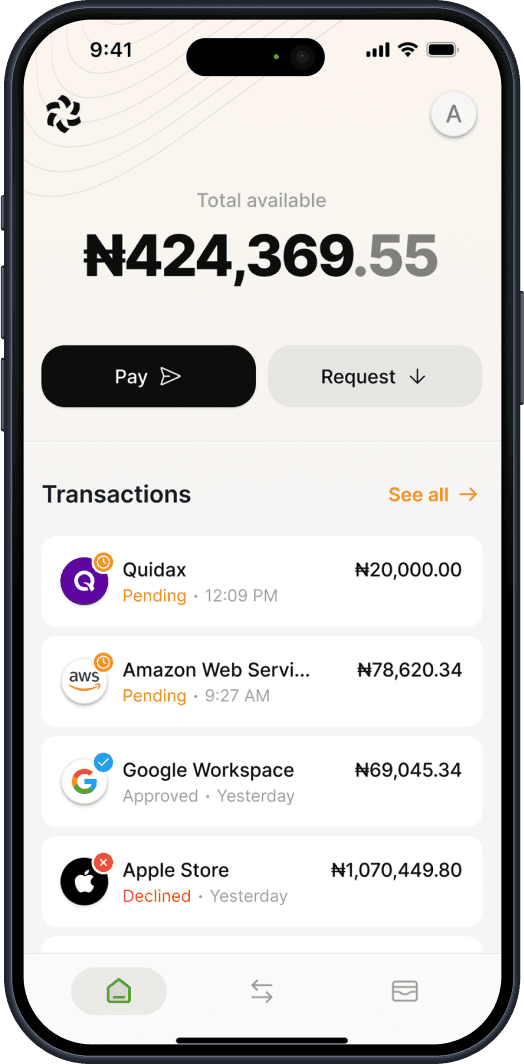
Bujeti gives every authorised stakeholder a live dashboard updated in real time across every account, card, and budget in the business. The moment a transaction occurs, it's visible. Instant notifications go to the right people when spending happens, anywhere in the organisation.
Patterns that would take months to surface in a quarterly report become visible immediately.
Cards that enforce the rules automatically
The untracked cash float is one of the most persistent sources of financial leakage in Nigerian businesses, and it's entirely solvable.
Cash is anonymous. It doesn't generate receipts automatically. Structurally, it is the easiest way for small amounts to disappear consistently without triggering any alerts.
Bujeti issues individual virtual and physical cards to employees, each configured with specific spending limits, approved merchant categories, and validity windows. A logistics officer's card works only at approved fuel stations. A marketing card covers only pre-approved categories.
Any transaction outside those parameters is automatically declined. No cash to lose, no receipts to chase, no end-of-month headache. The card is the control.
Why Bujeti and not something else?
Your bank offers corporate cards. Accounting software exists. You might even be wondering what makes Bujeti different.
Here's the distinction: most financial tools were built for businesses operating in stable, predictable environments with mature banking infrastructure. Bujeti was built specifically for Nigerian businesses, in naira, for local operating realities.
We understand that your finance officer might be managing vendor payments while sitting in traffic with an unstable network. That month-end can't wait for the three-day bank reconciliation delays. That you need controls that work even when the person approving payments is travelling between Lagos and Abuja.
Bujeti isn't just expense tracking software. It's spending infrastructure designed to work the way Nigerian businesses actually operate, with the specific controls needed to address the specific risks you face.
The real cost of doing nothing
If your business generates ₦100 million annually and loses just 3% to internal financial leakage, that's ₦3 million in profit or growth capital. Over five years, that's ₦15 million. Enough to open a new location, fund a product expansion, or weather a difficult quarter without stress.
Here's what makes this particularly urgent: the cost of preventing internal theft is a fraction of the cost of discovering it.
Bujeti's investment pays for itself the first time it prevents a single fraudulent transaction. And unlike the ₦15 million lost to poor controls, it's a known, predictable cost you control.
Beyond the numbers, when internal theft is discovered, trust collapses. Good employees become suspects. Investigations disrupt operations for months. Relationships built over years unravel in days. Legal proceedings drain time and money. The business you built starts to feel like something you no longer recognise.
Prevention is not expensive. Discovery is.
Stop finding out what happened to your money after it's already gone
You didn't navigate everything it takes to build a business in Nigeria to have it quietly drained by systems that were never designed to protect you.
Bujeti gives you:
Real-time spend visibility across every team, card, and account
Smart cards with built-in limits that enforce themselves
Multi-level approval workflows with proper audit trails
Live budget tracking so money only moves where you've authorised it
Role-based access, so no single person can unilaterally control financial transactions
Built for Nigerian businesses. In Naira. For local operating realities.
What to expect when you book your demo
In 30 minutes, we'll walk you through exactly how businesses like yours are using Bujeti to eliminate financial leakage, replace manual reconciliation, and build the kind of spending infrastructure that protects growth instead of quietly undermining it.
Come prepared with:
A rough sense of your monthly operational spending
The number of people who currently handle company funds
Your biggest current headache around expense management (we'll show you how to solve it)
No complicated setup. No long-term lock-in. No more chasing receipts that never arrive.
Book your free Bujeti demo today
Just clarity, control, and the confidence you've earned.