Why growing businesses need governance controls, not just approval emails

Tobi Omoyeni

For most businesses, financial controls start simple. A founder approves expenses. The finance lead reviews vendor payments. A spreadsheet tracks what was spent and who signed off.
For a while, it works. Then the business grows.
More employees submit requests. More vendors need onboarding. More invoices need approval. More money moves through the organisation. The systems that once felt manageable start to crack under the weight of that complexity.
Approvals get missed because they were buried in someone's inbox. A vendor is added without the right review. A reimbursement slip through outside policy. A payment is approved, but nobody can explain why six months later.
When audit season arrives, finance teams spend weeks reconstructing decisions that should have been documented automatically. This is often treated as a people problem. It isn't. It's a governance problem.
Informal controls work when one founder approves every expense. They become fragile when approvals are spread across departments, branches, and teams. Every growing business eventually reaches a point where trust must be supported by systems.
Governance is what allows that transition to happen without losing control.
Approval is not governance
Many businesses mistake approvals for governance. They are not the same thing. An approval answers a single question: Can this happen?
Governance answers several:
Who should approve it?
Under what conditions?
What policy applies?
What happens if nobody responds?
How is the decision recorded?
How do we prove the process was followed later?
An approval without policy enforcement, accountability, and auditability is simply a decision.
Governance is the system that surrounds it. As businesses scale, that distinction becomes increasingly important. The challenge is no longer whether spending gets approved.
It is whether financial decisions are being made consistently, according to defined rules, with a clear record of what happened and why.
The gap between policy and practice
Most finance teams already have policies. The problem is that policies written in a document and policies enforced in practice are rarely the same thing.
A policy may state that payments above a certain threshold require two approvals. Another may require procurement to use approved vendors. But if that rule lives in a PDF nobody reads and approvals happen through email threads, WhatsApp messages, Slack conversations, and verbal agreements, the policy is theoretical at best.
As businesses scale, this gap widens. More teams, more vendors, more transaction types, and more people making financial decisions, each of which carries risk if there is no structured way to route, approve, and record it.
Finance teams end up caught between two uncomfortable positions: either they create so many manual checkpoints that they slow the business down, or they relax controls to keep operations moving and quietly accept the risk that comes with it. Neither is a good option, and neither should be the only choice available.
Consider a logistics company with separate procurement, operations, and finance teams. Each team has a budget. Each team lead has authority to approve spending up to a certain amount, and above that, it goes to the CEO. In practice, approval requests come in through email, Slack, and the occasional phone call. The CEO is copied on some and missed on others. A vendor payment goes out that should have had a second sign-off. Nobody catches it until the monthly reconciliation. By then, the vendor has been paid, the transaction is closed, and the audit trail is a thread of messages scattered across three platforms.
Nothing fraudulent happened. But the process failed, and when the auditors arrive, that becomes a very expensive problem to explain. This is not an edge case. It is what financial operations look like for most growing businesses before they put the right infrastructure in place.
Without defined governance, each step depends on manual coordination. With governance controls, approval paths, policies, and accountability are already embedded into the process.
Introducing Governance Controls on Bujeti
Governance Controls helps businesses build governance directly into how financial decisions are made, approved, enforced, and recorded. Instead of relying on people to remember policies, businesses can configure controls that run automatically across financial workflows.
The result is stronger oversight without creating unnecessary operational friction.
Approval rules for financial workflows
Approvals are no longer limited to payments. Businesses can now configure approval workflows across vendors, invoices, bills, reimbursements, and payments.
Rules can be defined based on transaction type, amount, category, vendor, department, or other business conditions. A procurement payment can follow a different approval path from a vendor onboarding request, while still maintaining consistent oversight across both.
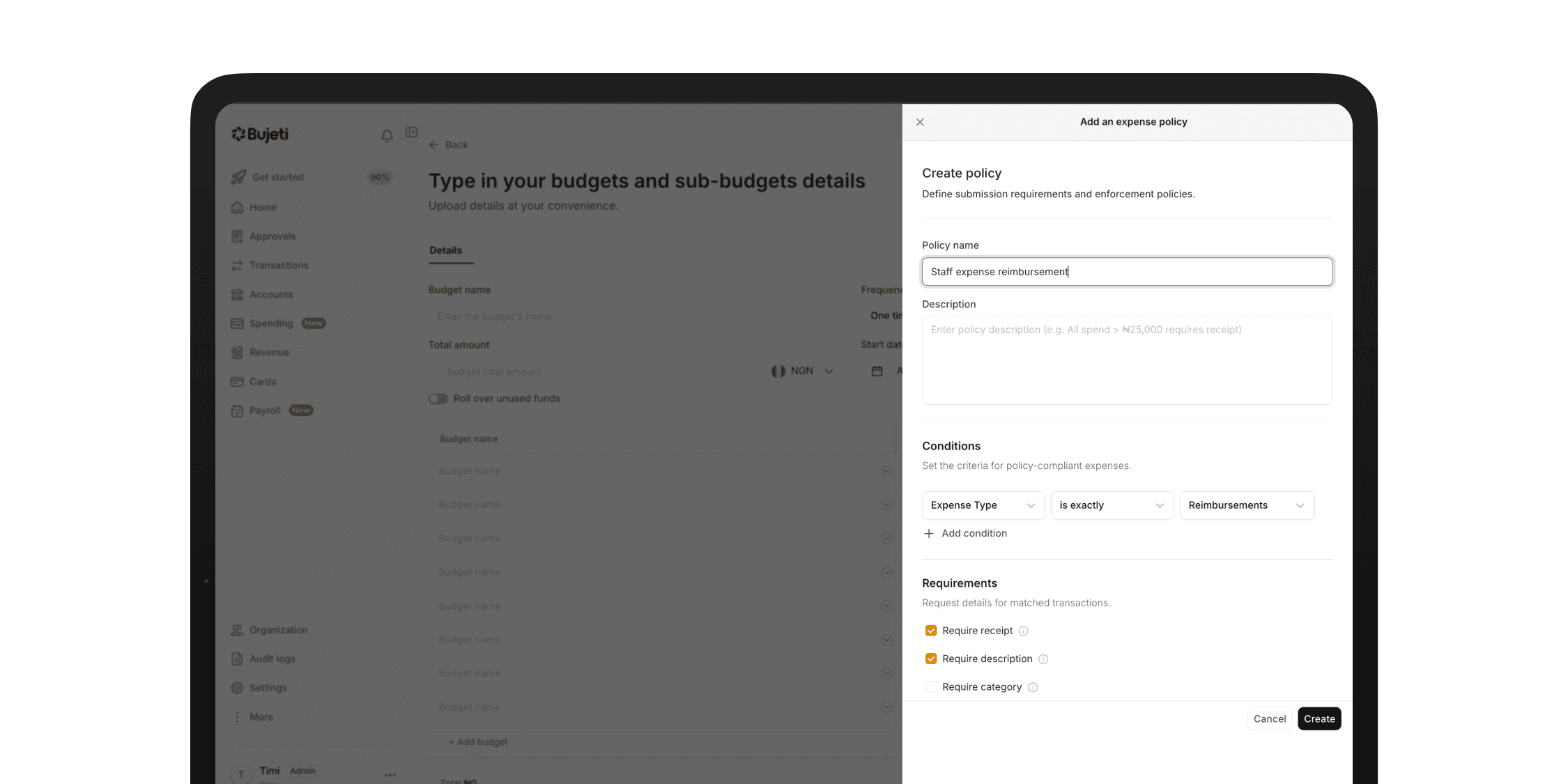
Expense policies and spending controls
Policies only work when they are enforced. Embed policy rules directly into your financial workflows. Set policies by category, vendor, or budget, define reimbursement caps, and restrict or flag specific vendors. Policies are enforced automatically, so spending stays within the rules without manual review of every transaction.
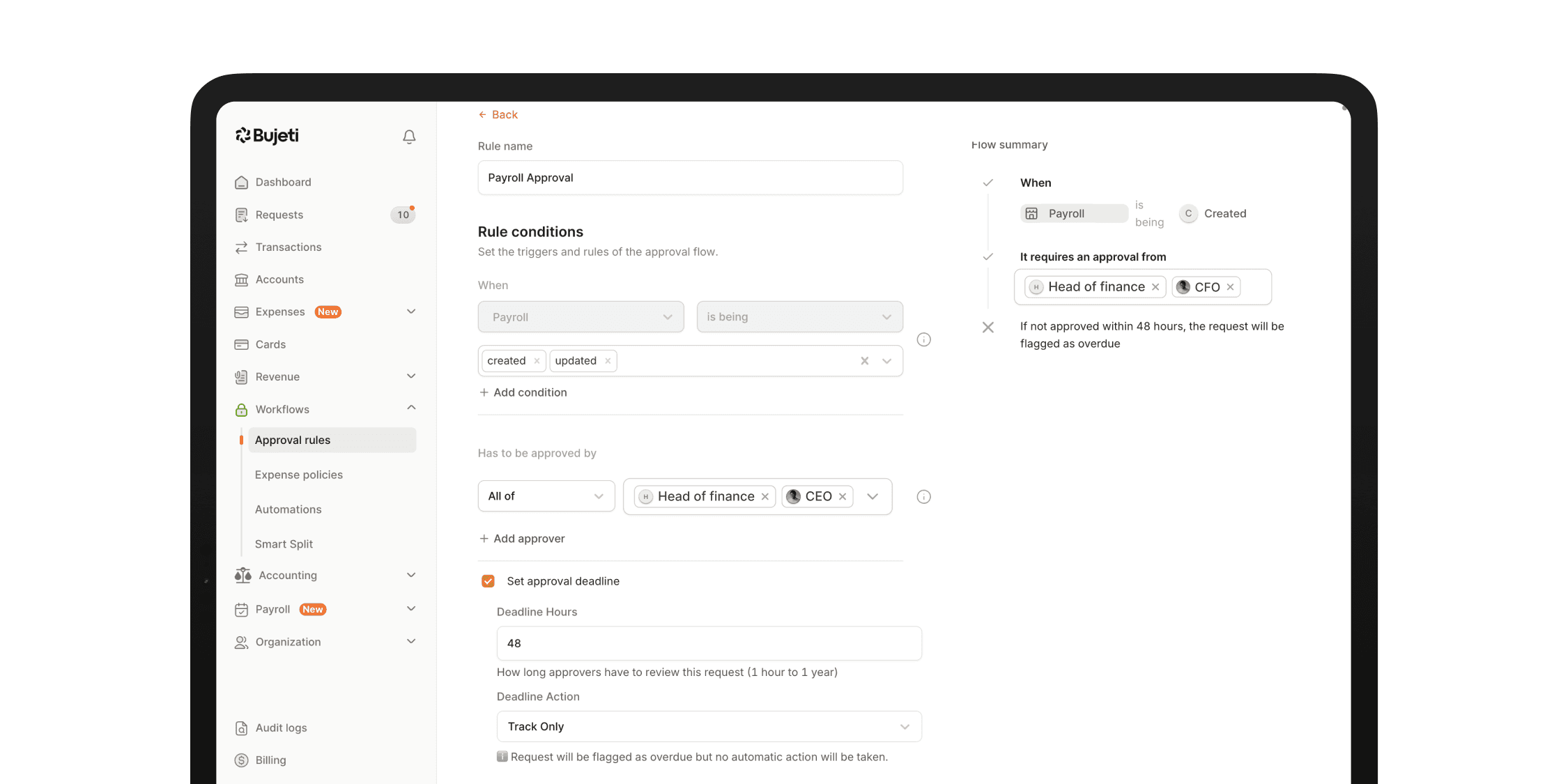
Approval deadlines
Configure automatic actions when approvals are not completed within a defined window. Options include auto-approve, auto-reject, or flag for follow-up. This keeps financial operations moving without creating compliance risk when an approver is unavailable.
Approval templates
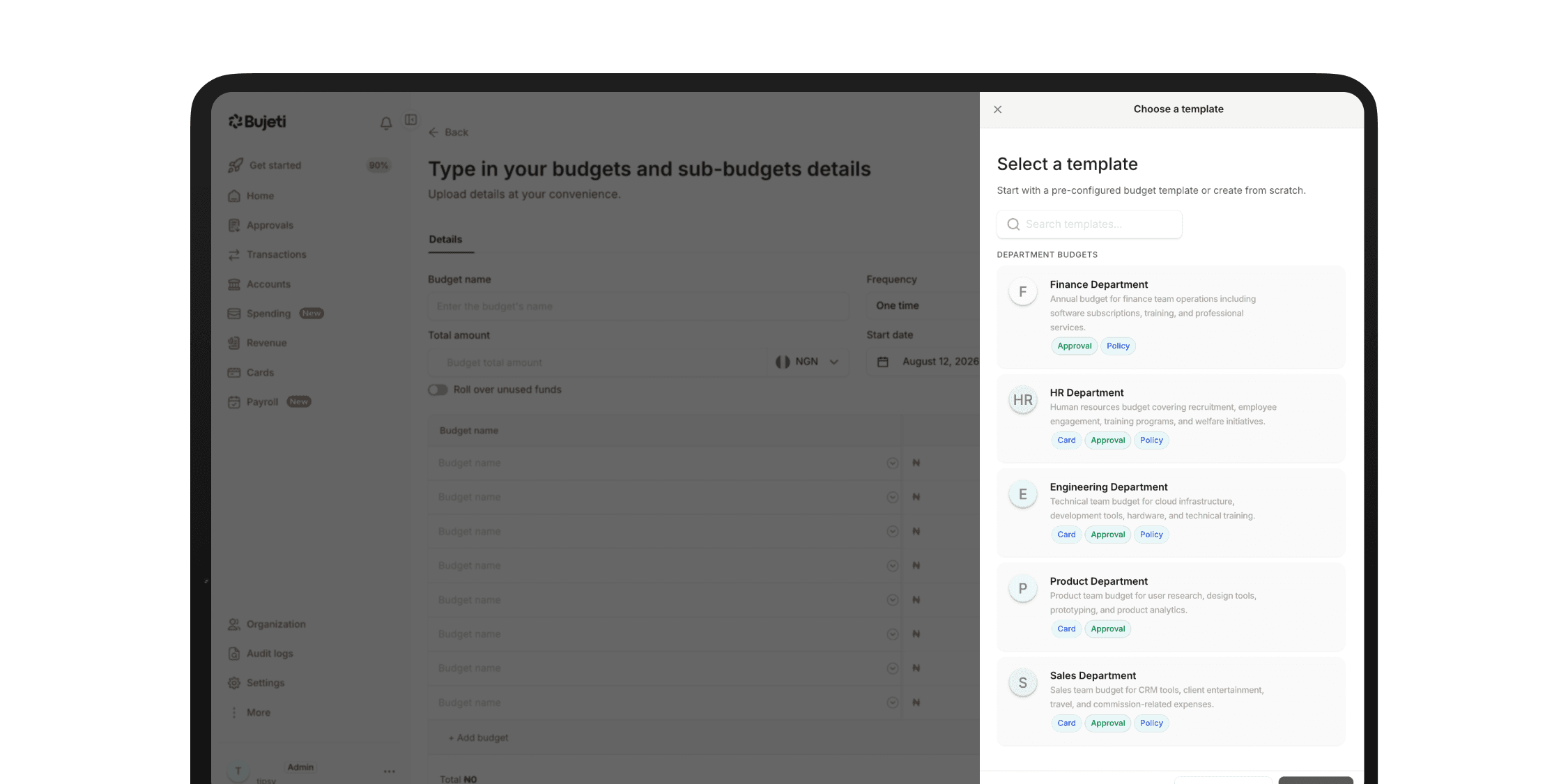
As businesses grow, financial controls should become easier to deploy, not harder. Governance Controls includes pre-built approval templates designed around common organisational structures.
Teams can start with a proven framework and customise it to fit their departments, projects, branches, or entities.
Audit logs
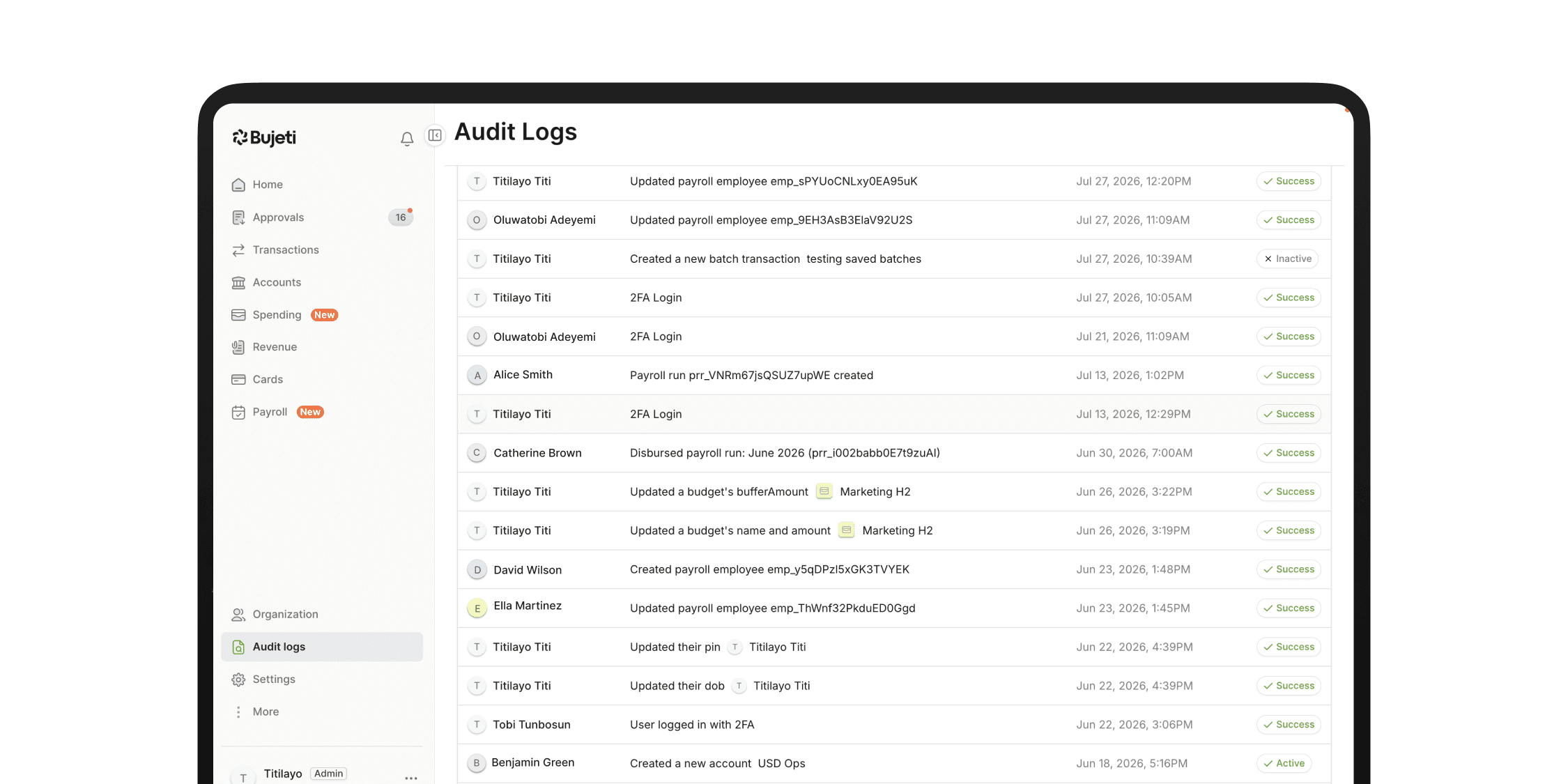
Governance is only as strong as your ability to prove it. When an auditor, executive, or board member asks why a decision was made, the answer should never depend on someone's memory. Every approval, policy exception, workflow update, and financial action is recorded through Audit Logs.
Each event is timestamped, searchable, and linked to the user who performed it. When questions arise, the evidence already exists. This is valuable during audits, but equally important for day-to-day financial management.
Visibility should not begin when something goes wrong.
The cost of weak governance
Weak governance rarely shows up as fraud. More often, it appears as:
Unauthorised spending
Policy exceptions that go unnoticed
Duplicate payments
Approval bottlenecks
Delayed vendor onboarding
Compliance issues
Endless audit preparation
The cost is not always visible on a financial statement. It appears in lost time, operational friction, and the growing effort required to maintain oversight as the business expands.
The larger the organisation becomes, the more expensive those inefficiencies become.
Governance should prevent problems, not document them afterwards
Traditional financial controls are largely reactive. Finance teams review transactions after approval. Exceptions are discovered during reconciliation.Auditors identify issues months after the original decision was made. By then, the money has already been moved.
Modern governance works differently. Instead of identifying policy violations after the fact, it prevents them before they happen. Approval paths are defined in advance. Policies are enforced automatically. Exceptions are visible immediately.
Every decision is recorded as it occurs.
Governance becomes part of the workflow rather than a review process that happens afterwards.
Built for businesses that are scaling
The businesses that benefit most from governance controls are rarely the ones experiencing compliance failures.They are the businesses growing quickly and preparing for the complexity that growth introduces.
Every new employee, vendor, department, branch, and entity increases the number of financial decisions being made.The challenge is not transaction volume. It is a decision volume.
Governance Controls help businesses absorb that complexity without increasing the manual effort required to maintain oversight. One finance team can establish controls that govern thousands of financial decisions while maintaining visibility into every approval, exception, and action.
Governance should not depend on memory
The businesses that scale successfully are not the ones with the most approval emails.They are the ones who build governance directly into how financial decisions are made. When approvals, policies, accountability, and auditability work together, governance stops being a manual process and becomes part of how the business operates.
That is what Governance Controls is designed to do. Governance Controls is now live on Bujeti.